Wednesday, 13 April 2011

23) High fashion in Argentat


Argentat, on the upper Dordogne
Although we had already more or less decided to buy La Borde Neuve in Cezac, we had an email from an agent in Argentat enclosing some very tempting sounding houses.  Argentat is a couple of hours drive from where we are staying, so we decide to go.  By way of a sort of inverted snobbism, we had always said we would not buy in the Dordogne because it is so fashionable with the Brits.  The area round Argentat, though, is in the Correze, and very different from what most people think of as the "Dordogne" (or so we thought from our first visit there).

It is very different, as our delightful agent was only too willing to explain, as he drove us (rather distractedly)  round vertiginous hairpin bends, high above the spectacular sheer drops down into the valley below.

It rains quite a lot, and in the winter a thick mist hangs over the river for most of the day, making it cold and dank.  Above the river, up on the hills, it tends to be cold and often windy.  During the summer, though, it is stiflingly hot in the river valley, with high humidity making it seems even hotter than it actually is, and particularly uncomfortable.  Argentat, we were ,told has an indigenous population of only about a thousand, but this swells to twenty thousand in the summer when the tourists arrive.  During the winter everything closes and the place is closed and dead.  As a consequence, the agent told us, everyone looks forward to the time when the tourists start to arrive and the place starts to come alive once again.  He went on to say, though, that this feeling only lasts for a week or so, before everyone gets thoroughly fed up with the tourists; there is nowhere to park, all the prices go up, and you can’t get into any of the restaurants.

A fascinating piece of history we saw near Argentat
If we had the benefit of this somewhat unusually honest and candid sales pitch before we made the journey over, we probably wouldn’t have bothered.  We did see a couple of fascinating houses (including this one above), but we felt this probably was not the area for us after all.

2011 Spring fashions in Argentat
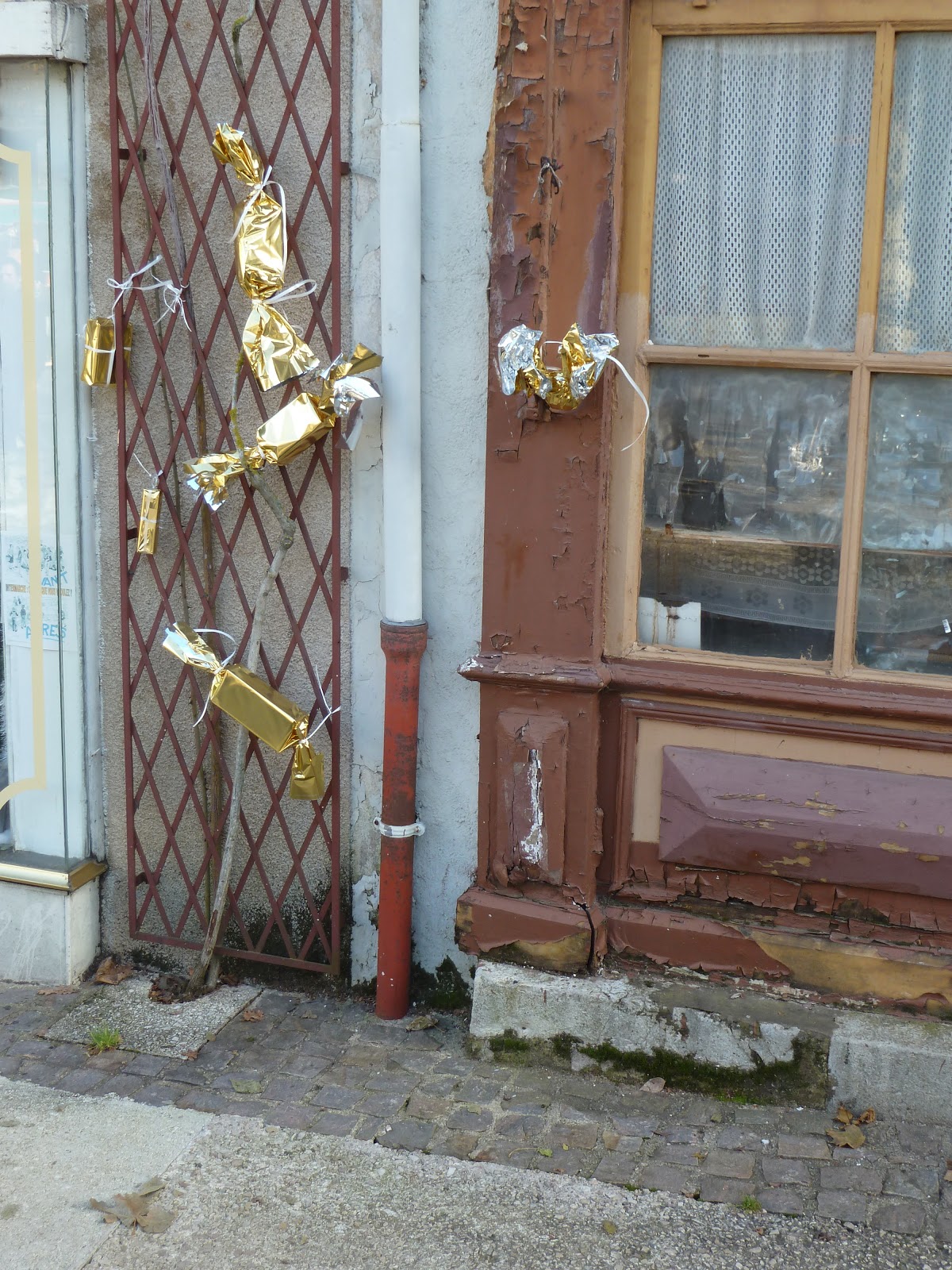
As can be seen from the picture at the top of this post, Argentat sits in a beautiful position straddling  the river, with tasteful, fashionable houses making its banks look picturesque and inviting for the wealthy and discerning (or, at any rate those who unaware of the downsides re: fog, winter closures, humidity, tourists etc.)As such you would expect to find the sort of shops to cater for the rich and famous, with the latest fashions arriving simultaneously with those on the streets of Paris.

What you actually find, though, is this.  Now I am no fashion guru (as I am sure Georgi would readily attest), but to my eyes this was not the epitome of high fashion I had expected to find in such a place.  What would Carla Bruni or Segolene Royal, chancing upon this item, so delicately displayed between a drainpipe and an ad’ for a speed dating soiree make of it?  Perhaps this is another opportunity?  We must go back in the summer to check out the potential punters.

Carla and Nicolas
Segolene Royal
                                        

Tuesday, 12 April 2011

22) A bus ride in France


Interior of a (very clean) French bus, Aurillac
Shortly before we visited England in March, we needed to get the car serviced.  I might have waited until we got back to the UK, but every time you started the engine, an irritating “binging” sound came on, together with an increasingly urgent red flashing message telling you the service was now overdue.  As the car’s warranty had run out three weeks earlier, I felt I really shouldn’t ignore this rather bossy Teutonic, but undoubtedly sensible, advice any longer (I also thought the “binging” sound might drive me mad).

Aurillac has the reputation of being the coldest town in France, but it happened to be the nearest place with an Audi dealer.  The garage was about two miles from the centre of town, in a sort of industrial zone.  Despite my having looked up the French for “courtesy car”, the garage seemed to regard this as something accorded only to Government Ministers, 5 star Generals and other such elevated personages.  As I was clearly neither a high ranking official, a famous footballer or even a champion boules player, there was no way they were going to give me a courtesy car, so instead we thought we'd take a bus into town.  I had been on buses in Rome (that’s another story), but neither Georgi nor I had been on a bus in France.

They were all very friendly, and it was immaculately clean.  First we asked an adolescent youth, who was hanging around the bus stop, which number we should take for the centre of town.  He didn’t seem to know, but as soon as we engaged him in polite conversation, he seemed very anxious to disengage himself from us.  I suspect he was either selling drugs and thought we were some sort of sneaky ploy the gendarmes had come up with to trap him, or perhaps he was just trying to keep up appearances of being streetwise and cool.  Engaging in conversation with an Audi owning, middle class, middle aged couple could, quite possibly, obliterate what little street cred he may have already acquired by loafing about menacingly in bus stops.  Of course, in reality, before he managed to get away, he was very polite, as all French kids are.  They seem to have a sort of reflex action if you speak to them.  They respond with politeness if not charm.  However surly or threatening they are trying to be, they just can't seem to throw off that universal (other than in Paris) French civility.

Then, when we got on the bus, a further good Samaritan came to our aid.  We paid for our tickets which were disgorged from a machine next to the driver.  We picked them up and started to walk down the bus.  Monsieur! the driver called out, and then she glared at us expectantly.  Les tickets, les tickets! she said, with a certain incredulity and even a note of panic.  Baffled, we looked blank (and, perhaps, rather British) as we began to feel the onset of a mild anxiety attack.  At this point a kind passenger who had noticed we were foreign, retarded, English, or simply clueless, pointed out that we had to put our tickets back in another machine, next to the first one, before taking our seats.

Having done this, Georgi and I walked sheepishly to the back of the bus.  On examining our tickets we discovered the second machine had stamped the time on them.  It appears the tickets only entitle you to a maximum of an hour on any one journey.  We presume that this is to prevent tramps from spending all day on the bus, just going round and round Aurillac (rather a draconian measure, given its reputation for coldness).  The more we thought about it, however, the more barmy the system of self-ticket stamping seemed.  Why didn’t the first machine simply print the time on the ticket?  Is there a fortune to be made here, developing an all-in-one-bus-ticket-issuing-machine?  Surely someone has already thought of this?  There must be something deeper behind all of this.  We haven’t worked it out yet, but I do wonder if Clouseau hasn’t had something to do with it?


Saturday, 9 April 2011

21) A new home in France

Spring flowers in the Quercy Blanc

Spring has arrived in the Quercy Blanc (the area just SW of Cahors, where we are staying).  Everywhere is a riot of wild flowers, cuckoos are cuckooing and we even saw a Hoopoe (Huppe in French) hoopoing.  That is to say Georgi saw a Hoopoe (twice), but I haven’t actually seen one yet (in order to be able to verify/substantiate this claim – though I did see a shooting star the other night which Georgi missed.)

La Borde Neuve, Cezac
Our main news, though, is that (having now seen a total of fifty one properties) we have bought a house! That is to say we made an offer, had it accepted, and on Friday 8th April we signed the Compromis de Vente.  We now have seven days to change our minds, after which we are pretty much committed, unless something horrendous turns up in the Notaire’s searches.  There is a great deal we need to do to the house, so we have made it a condition that we get all the relevant permissions before we sign the final contract (there are thus still things that could go wrong).

The little un-restored farmhouse at La Borde Neuve
As well as the main house, La Borde Neuve (which means New Farm in old French) has another little house.  This is currently uninhabitable, having neither electricity nor water, and the two vaulted cellars at ground level are not connected to the two rooms above reached by the outside staircase.

View of the potential garden behind the house
It has a potentially nice garden, at both the back and the front (in fact everything is “potential” rather than “actual” at the moment)   We always said, after spending sixteen years doing up Gressingham, just to move out a few months after it was finally completed, we would never take on a major restoration project again.  C'est la vie............

View from the Pigeonnier over the front garden towards the hills beyond
On the SW corner of the main house, there is a tower (Pigeonnier) from which you get great views of the surrounding countryside.  Although these towers are known as Pigeonniers, they seem to have very little to do with pigeons.  They are very typical of this region and seem to be a sign of status rather than serving any particular purpose.  Various theories have been put forward to us about their origins.  Some say that they really were for keeping pigeons, and if you could afford to build a stone tower just for the pigeons, then it showed everybody you had more money than you needed.  Others say that pigeons were a delicacy, so if you could eat them regularly at meal times, this was a measure of your success and worth.  Another theory is that these towers were where the dung was kept (a very valuable commodity not long ago – and still considered so by several famers in the Lune valley).  It might, therefore, be thought of as an early form of slurry tank. We won’t use it for either pigeons or merde, it will simply be part of the house.

View from the terrace at the front down the valley
Outside both the kitchen and the salon, there is a terrace which runs along the whole length of the house.  As this faces south, we think it will need some sort of shade, and we may make it into a (covered) Bolet in due course.

The septic tank at the far end of the "annexe"
This is currently the barn, which is attached to the west side of the house.  We are not, however, referring to it as a barn, as this might mean planning permission would be needed for “change of use” to living accommodation.  The “annexe” houses (rather charmingly) the fosse septique (septic tank).  This is the distinctly dodgy concrete structure on the right of the picture.  We have had an “expert” from SPANC (Services Publics d’Assainissment Non Collectif) to check this out and, surprise surprise, they have declared it “Non Acceptable”.  However, we went to see the person in charge of sewage disposal at the Mayor’s office, and she was a charming young lady (somewhat embarrassed by the small size of her office – which, clearly, she felt didn’t do justice to the worth and importance of her position), who is now our best friend.

They obviously take matters very seriously when it comes to the disposal of human excrement (and we are delighted they do).  Most of France does not have mains drainage so there is potentially an awful lot of merde simply going into the soil by way of (often dodgy, out of date, clogged up or broken) fosses septiques.  We have another appointment on site with the lady from SPANC (a slightly weird sounding acronym, given the circumstances) on the 18th.  Together, we are going to plan the ultimate system to deal with our projet, and we are looking forward to the meeting in a state of high excitement and anticipation.

The attic, which will become a studio, office and additional bedroom
The attic of the house is not quite finished, and this is where my studio is going to be.  It is a large space which reaches up to the ridge of the roof.  It is rather good, in a way, that it is not finished as it allows us to get things exactly as we want them.  Although the house looks old it is actually a kind of hybrid, a bit like Gressingham.  It is built from old Quercy stone on the foundation of some old stone barns (the walls of which still remain in places on the ground floor).

As several people have pointed out, space for animals was always considered more important than that needed for humans.  Often, therefore the houses are rather small and the barns and stables are much bigger.  We presume the little house was the original farm house then, about forty years ago, the present owner’s parents decided to re-build a bigger house on the site of the barns.  They only used part of the house and never bothered to do anything with the attics or the ground floor.  We won’t be able to do everything to start with, but we should be able to afford to get the two main floors finished and how we would want them, in the first phase.

Interior of the original farm house
The little house still has all its original features – Quercy stone floor (heavily cracked), open fireplace in the kitchen, stone sink with drain hole to the outside, and stone vaulted cellars.  This will be a project for some (unspecified) time in the future.

The main sitting room/dining area
The main living room or salon is fairly featureless at the moment but it does have a great big open stone fireplace.  It also has two French windows leading out on to the terrace and is a very good size, so can incorporate a dining area as well.  We were amused (but not surprised) to see also that, when they decided to wallpaper the walls, they didn’t bother to move the (presumably rather heavy) piece of furniture, but simply wallpapered round it.

The big ugly (but very useful) barn at the far end of the garden
About a hundred metres (luckily) from the house is what the French estate agents describe as a “hangar”.  Although supremely ugly at the moment, it is far enough away not to intrude unduly, and “one day” could be faced in stone and converted into something more desirable.  In the meantime, it might be useful for storage – and it even has an excellent series of chicken coops (and a run) at the side.  I am rather keen on the idea of chickens, but Georgi seems very much against the idea (“Who’s going to end up looking after the clucking things whilst you’re in your studio painting?  And are YOU really going to wring their necks or cut their [bloody] throats? etc, etc.”).  Watch this space...........

Our virtual swimming pool

For the past week the temperatures here have reached into the mid eighties (it’s still only early April), and we shall definitely need a pool.  This has, though, started to exercise our resolve as we investigate the regulations relating to pools and the different designations of land.  At La Borde Neuve we have twenty one and a half acres, in four parcels of land as shown on the official Cadastre.  Each of these has a different description – SolTerreTallis/Terre, and Tallis/Lande.  Quite what these all mean, I don’t exactly know (and I suspect no one really does – or cares).  It seems, though, that the designation affects the rate of local tax you pay (farmland, for instance, attracts a higher rate than woodland apparently).
 However, just to make things even more complicated, half the land has an overall category as farmland, whilst the other half is in a special category “N” zone (a sort of French equivalent of the English conservation areas).  We are still delving into the whys and wherefores of what you can do in terms of pools, but they don’t seem to stop them, they just try to determine how far away from the house they should be, and what colour you can have them.  It has been decided by minds much more elevated than mine, that blue is an unnatural colour (even though more than half the world is covered by [often blue] oceans, and the whole of the world is covered by [often blue] skies).

A rare orchid before being destroyed by Monsieur MacGreggor
On our last but one visit to the house, we were thrilled to find lots of orchids in the garden (apparently this region is well known for its orchids, several varieties of which are unique to the Qercy Blanc).  Sadly, on our next visit a few days later we found the lawn had been mowed, and most of the orchids had been decimated (I think some of the rural French are a little less sentimental than we are).  Hopefully they will come up again next year, and we will no doubt cause great amusement amongst the locals as we create strange patterns on the lawn in an effort to mow round them.

Another thing the area is known for is black truffles and one of the biggest truffle markets is just about twenty miles to the east.  We have several acres of oak wood and I am determined to discover truffles - all we need is a pig.

Wednesday, 16 March 2011

20) Interim Posting

Unusually named petrol pump, Salvetat les Peyrales
Whilst we are in England, the blog is going to be largely suspended.  However, shortly before we left France we found this rather old, beaten up, and somewhat defunct petrol pump.  Despite it having absolutely no resemblance whatever to anyone we know, it did have a rather unusual name for a brand of petrol.  I couldn't resist.  So this is just a little interim soupcon, and is dedicated to one of our favourite blog followers!

Tuesday, 1 March 2011

19) Noel, Noel........................


Twelfth night in France does not seem to be the deadline for taking down Christmas decorations, in the same way that it does in England.  It is now March, and you still find the dying remnants of Christmas "decorating" the streets.

This one, I am sure, had a particular storey to tell.  What were the thoughts behind it, the sentiments, the sense of design, (or was it intuition, rather than design, that had guided the placement?)  Was it the careful and considered work of some elderly, blind, but well meaning widow who wanted to add her bit of joy to the world of Christmas. Or perhaps a spotty, rebellious youth had been given a sharp clip round the ear before being dispatched to put up the obligatory Christmas baubles.  Hacked off and disgruntled by this humiliation, and the stinging sensation in his ear, he had been determined to make them look as crummy and ridiculous as he could.

Sadly we'll probably never know.  Perhaps we'll return to this street in Villefranche de Rouergue to see what goes up next year - or perhaps they'll still be there.

Monday, 28 February 2011

18) A magical sight


This is what we saw when we reached the top of a col on the way to see a house between Monestier and Cordes.  We just couldn't believe it.  These are the Pyrenees, and they are a HUNDRED MILES AWAY (I checked on Google Earth when we got back). I want to go there.  Just imagine if you were a buzzard - you'd probably see this sort of sight every day, as you soared high on thermals over the Quercy Blanc.

I've always thought, if there is such a thing as reincarnation, I would like to come back as a bird.  My ideal, up to now, has been to come back as a swift, but maybe a buzzard would be even better.  Swifts are such amazing flyers - and they seem to know it.  The thrill as they race around the sky, vying with each other as they show off their dazzling aeronautical skills.

The only problem, is their diet of flies.  I'm not sure I could stomach that.  Come to think of it, a buzzard's diet of small dead furry animals (raw) does not appeal that much either.  On the other hand, if you are a swift, bugs probably seem quite delicious.  Similarly, buzzards probably relish nothing better than a freshly dead field mouse, or a road kill rabbit carcase.  To be fair, they probably both think the idea of boiling sprouts and then eating them is disgusting.  And then who are we to squirm about flies and dead mice, when we (or at any rate, the French)  are quite happy to eat snails and frogs legs?  I wonder what they eat in the Pyrenees.

Sunday, 27 February 2011

17) Wildlife in France


There is a wide variety of wildlife in France.  But not as much as you would expect.  We think this is probably because of the Gallic predilection for shooting things.  Everywhere you go in the countryside you see little red (warning) notices declaring (ominously) Reserve de Chasse.  We assume this means if you venture along this path you may well catch a stray bullet, and this will be considered your fault for being in its path.  The apparent paucity of wildlife could, therefore, either be because the French have shot everything, or because the wildlife, having learnt about humans and their passion for guns, keep well out of the way and you rarely see them.


.
It could be a bit of both.  When we were staying in the Haute Loire last Spring and the snow came, we put out some bread for the birds.  To our surprise ,they didn’t touch it.  We enhanced it with the addition of some nuts but, again, they wouldn’t go near it, even though it went down to minus fifteen degrees.  We could only conclude that, after years of persecution by man (Frenchmen), they assumed it was some sort of trap, or perhaps poisoned or drugged (or perhaps they didn't want to be an easy target for buzzards - although I believe they only eat carrion).


One thing you see a great deal of is birds of prey, buzzards particularly.  Presumably they are fairly adept at keeping out of range.  And I don’t think even the French eat buzzards (being carnivores, they would be likely to make you terribly ill).  I know about this because I saw a fascinating programme on television about a stone age (or was it an ancient Egyptian) man who had died of some horrible disease, and they had concluded it was because he had eaten the liver of a lion (I can’t remember how they had worked this out, but it was very convincingly argued at the time). They pointed out that herbivores have to eat plants, omnivores (like us) can eat plants and animals-that-eat-plants, and carnivores (like lions and buzzards) can eat more or less anything.  When these rules are broken, things start to go wrong – as happened, of course, when farmers started feeding ground-up bits of animals to cows (herbivores).  You had BSE in the cows, and CJD in those (humans) who ate the affected cows.  A great pity the farming community/industry didn’t see the same programme (I think it was on BBC 2, though).


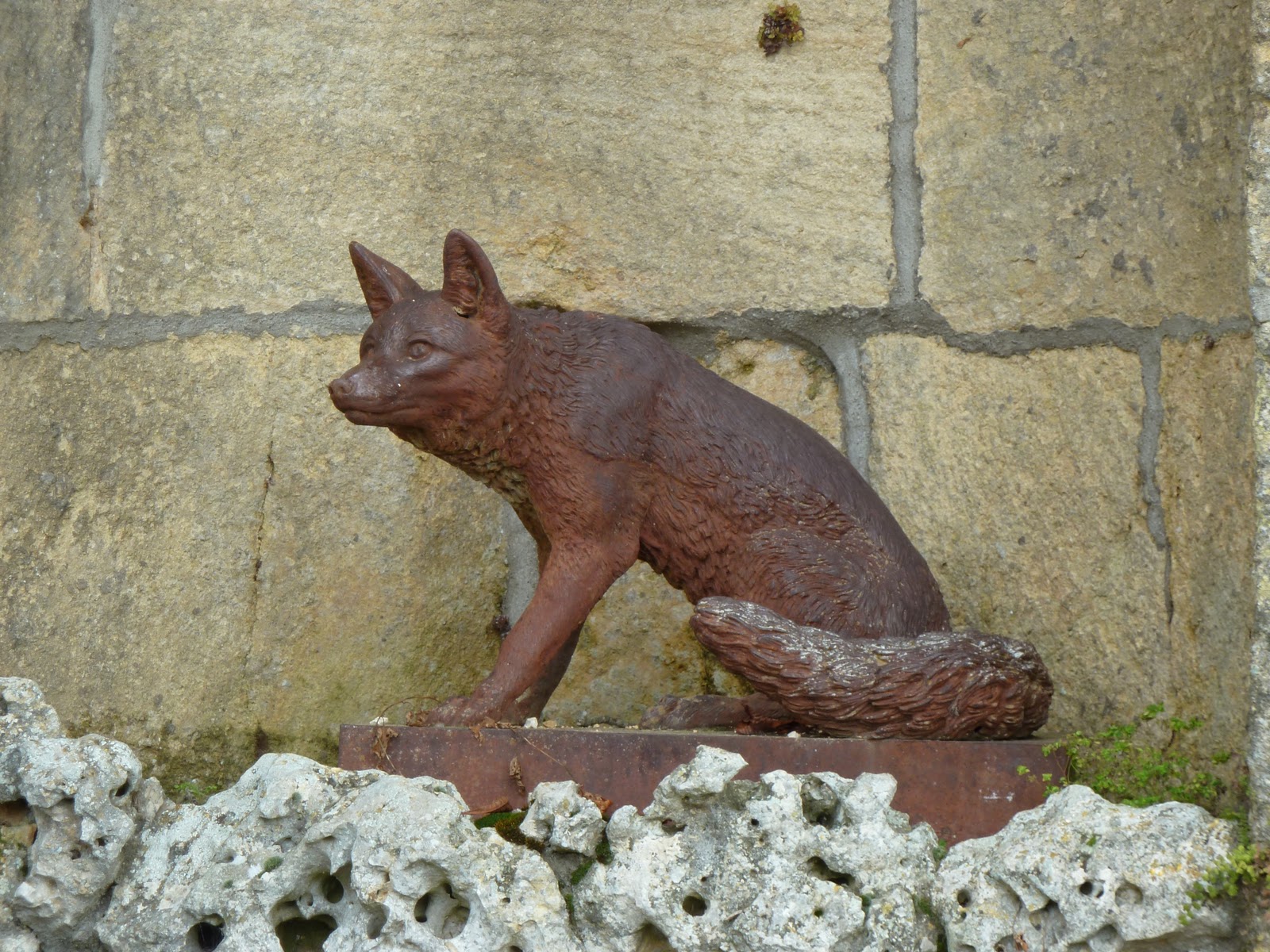
We were told by (our very knowledgeable and favourite) estate agent, Pierre, that foxes are very uncommon in France. He (being French) has lived all his life in France and has only ever seen one once.  Imagine our surprise and excitement, therefore, when we saw one quite close up after only a few weeks in France.  It was enormous.  At least twice the size of the ones you see in England, and nothing like the mangy beasts you now see all over London.  This one was truly magnificent (quite worthy of an iron statue in a Chateau – see above).

We wondered whether Pierre was accurate about his theory on the comparative rarity of foxes.  We were aware that those who keep chickens still lock them up at night in France.  We assumed this was to protect them from foxes.  Not so, we discovered, when chatting to an old English gent whose house we had gone to see (and who used to keep chickens).  After an appalling night of carnage and mayhem, he had decided to give up his chickens (those who were not disgorged and torn to pieces).  But it was not old Reynard who was the culprit, it was a renegade band of pine martens. It seems Pierre may have been right yet again.


The biggest thrill of all, though, was seeing our first sanglier (Pierre had only ever seen two).  You see foxes in England, and buzzards, and now kites, you even see red squirrels in the Lake District and Northumberland, but you will never see a wild boar in the wild.  It was so exciting. We were driving along at dusk behind a couple of cars, and suddenly there was a screech of brakes as the front one swerved  to avoid hitting something.  And then we saw it.  Galloping at break neck speed across the field to the left of us, turf flying, nostrils flaring, and the off into the woods on the other side.  All the times we have been to France, Georgi and I have talked about seeing a sanglier, but we never had until now.  (The photo above shows the exact spot, near Le Nayrac, where we saw our first sanglier).


This wonderful character turned up whilst we were looking at a house in the Aveyron.  He was a neighbour and had wondered who we were.  He was obviously bored and, much to the estate agent's annoyance, decided to tag along, giving helpful comments every now and then.  Comments such as "It's not so bad in summer, but it's a terrible place to be in the winter time" and "Of course it used to be quite grand, but the folk who live here haven't bothered to keep it up, and the whole place is falling in about your ears now" I was rather intrigued by this old fellow, who obviously had a certain insight concerning this property.  The agent seemed to take an instant dislike to him, and treated him, I thought, rather rudely.  I let Georgi go on ahead with the agent and hung back to chat to Monsieur.

The agent had been able to understand him no better than I could, his patois was so strong and thick.  It became apparent he was just as much part of the wildlife as the foxes, buzzards and wild boar.  We chatted about sheep and cows, and roofs falling in, and quite a lot about boundaries (particularly where his ended and the agent's property began).  He was very friendly and, despite talking in a completely incomprehensible dialect, surprisingly easy to understand.


As I child, I was always very fond of animals.  I had lots of pets; newts, frogs, rabbits, tortoises, budgerigars, hampsters and so on, and my favourite books were Dr Doolittle.  Often I would dream I could talk with the animals, and in the morning, the experience still seemed so  real.  I then read Conrad Lorenz, and learnt about the little ducklings who thought their mother was a pair of red wellington boots, and the jackdaws he made friends with.  I have never totally lost the dream  about the magic in animals.  Imagine my surprise then, when I suddenly caught site of a pushmepullyou.  Straight out of Dr Dolittle (except I think that was a goat), and right there in France.  I knew all those cynical grown ups would never believe me, but luckily I had my little camera to hand.  If the pushmepullyou really does exist, then surely it might also be possible to talk to the animals?