Friday, 3 February 2012

52) The start of a garden


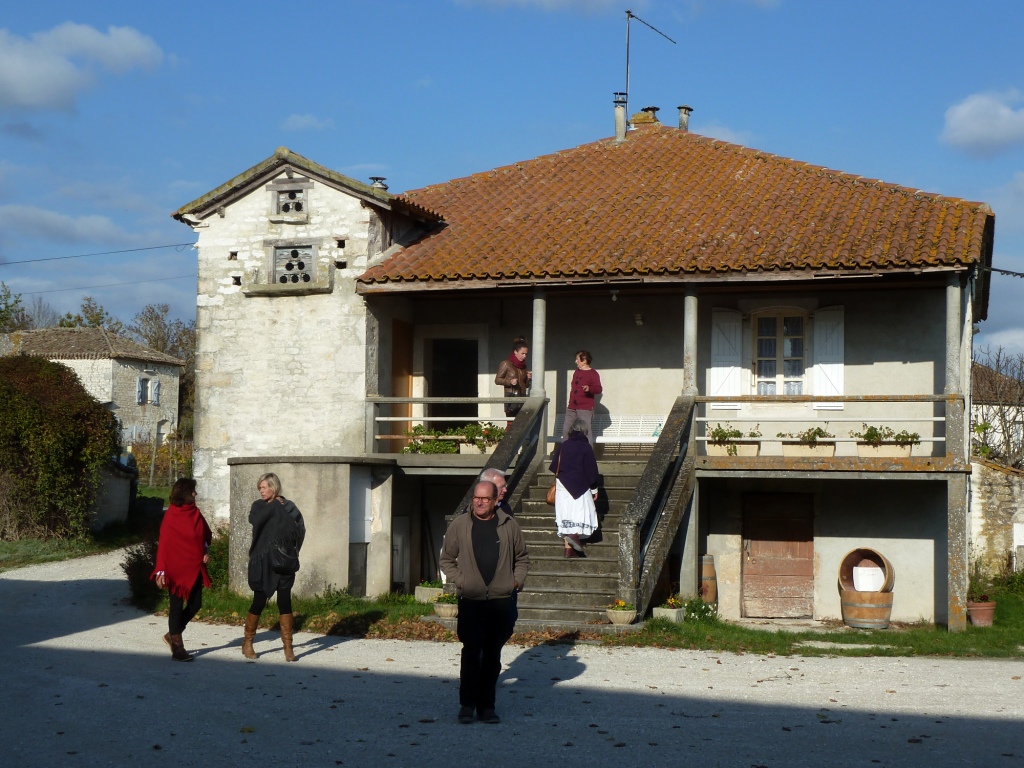
A yellow to orange rose with a strong fragrance to go in the new bed at the bottom of the steps leading up to the house.  It should flower most of the summer, and make a really nice welcome as you arrive.


Many of the houses around here have these needle like Cyprus trees like you find in Italy.   This area of France is sometimes called "little Tuscany".


We will try out different positions before it goes in the ground.  They help to frame the house in the landscape and eventually it will grow pretty tall.

Thursday, 2 February 2012

51) Snow!

La Borde Neuve 2nd February 2012

It has started snowing now.  But it is still a darn sight colder in our bedroom and bathroom than outside.  Perhaps we should try sleeping in the open air tonight?

Sunday, 22 January 2012

49) A new Year begins


Fireworks on New Year's Eve
A rather realistic plastic Father Christmas on display in Auchan  at  Villefneuve  sur Lot
Christmas has been and gone and I realised it is about six weeks since I updated the blog.  Lots has been happening (hence the delay) so I thought I would do a series of random snippets, sketching out what's been going on in our little corner of France.


It's got cold; and frosty.  But no snow so far, just bright stars at night and white hoar frost on the field in the mornings.


The good news is we have a smart (and very expensive) new boiler.  The bad news is at the moment it is only connected to the existing radiators (on the main floor).  Our current bedroom (the only room in the house not being trashed by the building work) is on the top floor (in the tower - four outside walls) along with the bathroom.  Both are FREEZING cold.


There is plenty of work to do and this helps keep us warm, as well as giving the impression progress is being made (engendering feelings of glowing self righteousness).


We found three local lads (with incomprehensible accents) to come and cut down three large trees which had long since died alongside the stream.  The deal was that they would fell them (safely), cut them up into half metre lengths (safely), and then move them up to the "hangar" (safely).  I just couldn't watch.  Monsieur Baussac, our insurance man from AXA, was most insistent when we saw him some months ago that we had cover for third parties injuring themselves on our property.  At the time I thought this was somewhat over the top, but that day I was more than pleased at his foresight.

I thought that the price seemed rather reasonable, but the lads had somewhat underestimated the size of the trees and the scope of the task.  A deputation came to re-negotiate the fee (at least that's what I think they were saying).  I relented and agreed an increase on the condition the job was completed completely.  Only it wasn't (quite).  Two problems.  One of the trunks at the base was thicker than twice the length of their (very dangerous looking) chainsaws (so they couldn't cut through it).  They assured me over the next couple of years it would shrink as it dried out and they would come back and cut it up then.


The other problem was that when one of them started cutting up the last tree to be felled, it turned out there was a nid de frelons inside it.  He insisted they were very dangerous, being the dreaded Asiatic hornets that everyone around here is so exercised about.  Actually they were European hornets (as I explained to him - no red band on the tail - now being something of an expert in the peu lambines).  Despite my new found expertise in the subject, I did have a certain sympathy for his concerns.

I had read somewhere that hornets were much less aggressive than wasps, but the one thing they got really angry and upset about was a threat to their nest.  Given this amiable maniac had cut down the tree containing the nest with a very noisy (and hideously dangerous) chainsaw (they apparently don't like loud noises either), causing it to crash to the ground, and then proceeded to cut it into half metre lengths (with no regard as to whether these cuts might slice up the nest), it was no wonder they were less than pleased and were buzzing all around him.  He insisted I come and see for myself, though I tried (and failed) to explain I was quite happy to take his word for it.  I approached very cautiously but,  to my relief I found most of them  were either dead, dazed, quite possibly deafened, but definitely disorientated.  Our local hero then suggested (gallantly) that perhaps he could come back on a day with a hard frost when the frelons might be a little less active (or perhaps dead).  Une bonne idee! I readily agreed.


As a consequence of this action packed day we now have around 25 tons of logs stored in the hangar, all of which have yet to be split.


Prior to the arrival of our new boiler, our only effective source of heat was a log fire in the salon so our supplies had become quite depleted.  Now we have hours of fun ahead of us turning large slices of tree trunks into usable logs.
.

We also had an uninvited guest turn up one day.  This hairy looking creature wandered into the kitchen, clearly having mistaken it (not altogether unsurprisingly) for the hunt kennels.  We quickly surmised he was from the chasse (he had a bell round his neck, a red collar with a telephone number on it, and he smelt of deer and cheap brandy).


The hairy pooch turned out to be quite friendly (despite warnings not to approach it), and it was rather nice to have a dog around again (albeit briefly).  The chasse over here is quite an institution and worthy of a separate blog post to itself.  Suffice it to say that they are very different to the English hunt, and I will attempt to elaborate at a later date.

Neither a truffle nor a cepe
We are convinced that we have truffles on our land, and we are now at the height of the truffle season.  We are in the middle of a famous truffle area but, of course, they grow underground.  Without a dog or a pig they are almost impossible to find.  Tragically, the only person we actually knew with a trained dog was recently murdered.  We did go hunting for cepes (unsuccessfully) and later found out that you won't find cepes and truffles in the same area.  You apparently have cepes where there are chestnut trees.  Truffles are found where there are oaks, or sometimes hazel or juniper, all of which we have in abundance.

The planning department building in Cahors 
Much (too much) of our time has been taken up battling with the infamous French bureaucracy.  This has ranged from car registration, the water board, EDF, telephones and television to health care, business registration and planning issues.  Again this merits a blog spot on its own.  We have traipsed through many long corridors of power, sat for interminable hours waiting our turn in queues (who said queuing was a peculiarly English habit), and all of this in some of the most spectacularly ugly buildings in the region/department/canton/commune.

Above is the planning department building in Cahors.  It is a wholly inappropriate design, in the wrong materials, out of scale and taking no account of the existing historical architecture surrounding it - the planners would never allow it (unless, of course, it was for them).  


At the house, however, it has been a hive of activity - and a veritable magnet for white vans.


......and yellow delivery lorries with their intrepid drivers-cum-crane operators (this bloke was a true artist).


Our two builders started work again the day we got back from England and we are hoping the plumbers may turn up sometime next week.


From scenes of dust and devastation like this one above we have now progressed to............


a more constructive phase - a temporary staircase..........


and the beginnings of walls in the new bedroom.


But what really pleased us was when this chap turned up to empty our ever-so-dodgy septic tank.


What a relief.  Ever since we moved in we had dreaded the moment when this ancient, cracked concrete edifice might collapse and disgorge its contents all over the floor of the barn.  Ugh....................


Our digger man was a real class act; very professional, very sympathique, and with a wry sense of humour.


First the new fosse septique went in, then it was filled with water.................


Next the filter bed was laid (a far cry from the rather archaic brick structure we had in Gressingham), and then everything was covered over with the topsoil which had been carefully kept to one side.  All that was then needed was a sachet of Eparcyl flushed down the loo to really get the thing fermenting nicely.  What a joy.  You find many people living in France become very involved with the whys and wherefores of their fosses septiques and you would not believe the satisfaction we get from a flush of the loo, knowing it's all now going into our brand new super duper multi chambered and officially certified system.


The only downside is the possible effect this may have on our walnut cultivation.  This year we had a spectacular crop from our single lone tree.  When we mentioned this to our neighbour he tapped his nose knowingly and pointed out that the outflow from the old septic tank fed right onto the roots of our walnut tree......


There are also still many eccentricities we continue to discover living in France, some of which puzzle, some exasperate, some are charming and some are wonderfully intriguing.........  We spotted the above in Cahors.  It actually turns out to be a bus stop.  Clearly a somewhat home made bus stop, utilising the wheel of perhaps a defunct bus (the French are very keen on re-cycling).  What really intrigued us, though, was that someone actually thought it might get stolen, so they have chained it to a street sign.


On returning from one of our frequent visits to the Mairie we came across a concrete lorry blocking the road.
There was no other road we could take without a detour of about thirty miles.  We turned the engine off and just sat there as five men spent the next twenty minutes or so to (rather leisurely) spreading the concrete.  We have (had to) become much more patient since living in France.


Finally - we spotted this on a back road between Cezac and L'Hospitalet.  Two blokes building what appears to be a still (presumably to make the brain curdling beverage, eau de vie).  I couldn't help noticing a resemblance to Fletcher and Mr Baraclough from the TV series, "Porridge".  I could just imagine that the bloke on the left had no idea what he had been asked to help build, but the mischievous one on the right obviously had everything worked out nicely.

Monday, 5 December 2011

48) Bathroom fittings

The downstairs bathroom and "en-suite" open-plan loo
Our two bathrooms currently leave a little to be desired.

The upstairs one (the one we use at the moment) has not yet got any heating and the shower has a mind of its own, oscillating without warning, and completely at random, between freezing cold and near boiling point.  It also does not appear to have a "U" bend so unsavoury smells from our (condemned) septic tank percolate into the small space of air trapped by the shower curtain - God I hate shower curtains; roll on the day when we get a DOOR.

The downstairs bathroom now has heating, but no door on one side.  The loo is in what will become our bedroom, and when the upstairs loo is flushed it sounds like Niagara Falls.  The light switch is suspended from a wire twelve inches off the ground, and any heat produced by the radiator rises up the old stair well into the un-insulated loft space where it dissipates into the upper atmosphere.  The cast iron bath takes the heat out of the hot water as fast as it comes out of the tap, and the plug doesn't fit so you have to hold it down in order to retain any water at all.

Loo roll holder for the super rich
We have thus been looking at bathroom stuff in keen anticipation of the plumber's arrival.  Generally the costs are more or less the same as the UK, but there is perhaps a wider gap between the cheap and the expensive, and little apparent reason why some items suddenly sore into the super-rich category.  Maybe we need to get out more, but we were fairly amazed to find a LOO ROLL HOLDER priced at 189 euros (about £165).  Do people really spend that sort of money on a loo roll holder?  Or perhaps it's the sort of opposite of a "loss-leader" - maybe it's a "profit-trailer".

The upstairs open-plan shower room with potentially valuable loo roll holder
When we got back we noticed that we had, in our upstairs (open plan) shower room a very similar loo roll holder which will now be going on le bon coin (the French equivalent of ebay) at the bargain price of 120 euros (plus postage).

Bog brush and holder for Royalty and the mega rich
We were equally, if not more, amazed (we get fairly amazed quite often in shops these days) to find a bog brush and holder priced at 201 euros.  If you paid over 200 euros for something, would you really want to stick it down a (by definition) dirty lavatory?  I was beginning to wonder if all of this was something to do with a contemporary interpretation of Marcel Duchamp and his urinal artwork.

The epitome of fine taste for the ultimate French bathroom suite
Happily we soon found exactly what we had been looking for.  A reproduction 18th century serpentine chest of drawers, finished in imitation gold leaf, and topped with a black plastic fake marble (or was it fake Corian) wash hand basin with a rather elegant modern "waterfall" chrome tap.  The whole ensemble was tastefully set off by a reproduction carved wood overmantle mirror in fake gold leaf.  I am now in the process of redesigning our bathrooms so that we will be able to fit one in each of them.

Saturday, 26 November 2011

47) Wine, Pastis and Rum


We were rather chuffed to receive an invitation the other day to taste the new wine at our local vineyard, the Domaine de La Garde.  It took place in the wine making sheds and  was organised and hosted by several generations of the family (the patron and chief vigneron, Jean Jaques Bousquet, can be seen here in the centre of the picture).  The old mother is just like a previous Director of Abbot Hall, but her teeth are even more challenging.  She is completely incomprehensible, as is her husband, due to their very strong Occitan accents.  Despite the fact it must be pretty obvious we only get one word in ten, they are completely undeterred, and prattle on nineteen to the dozen.

Unlike Beaujolais (nouveau), the new Cahors and Coteaux du Quercy wines will not be drunk yet, and the better ones won't be bottled for a couple of years.  The new wine had just finished its second fermentation and had not yet been blended.  We were thus able to taste the individual cepages in their raw state.  There was Merlot, Cabernet Sauvignon and, of course, the local, much coveted Malbec (or Auxerrois as it is sometimes called locally).  It was, indeed, pretty raw but that was no reason not to get well stuck in.

We seemed to be the only English there, but some of the locals seemed to be taking things quite seriously,   There was lots of swishing round in the mouth, sharp intakes of breath and other strange facial contortions so beloved by wine connoisseurs.  But somehow the French seem to appear less pretentious than the English when they take their wine seriously.  Perhaps they are not quite so earnest  And perhaps they take themselves less seriously.


We were surprised to see two unusually elegant ladies arrive (in the left of the photo above), and assumed they must be what passes for Cezac aristos.  Actually they turned out to be Dutch.


One of the reasons (other than the opportunity of free wine) we went along was to see the demonstration of making Pastis.  This is a Quercy speciality which we had seen for sale in the markets.  It generally sells for around 22 to 24 euros for one which would feed about eight people.  It is a pudding (that much we had gathered), but we didn't really know what it was or why it was so outrageously expensive.  Now we do.

It has nothing, apparently, to do with Pastis, the alcoholic aniseed drink, other than the word derives from an Occitan word meaning pastry (though what this has to do with the drink I have no idea).  Pastis (the pudding) does have alcohol in it, but rum not Pastis - all very confusing.

The demonstration took place in the vigneron's kitchen.  I was intrigued to see that our's was not the only house in the locality with a bare light bulb dangling from a piece of wire (see circled bit in the photograph above).  I noticed also that the wire had been rather cunningly looped round to reduce the likelihood of people banging their head on the bulb.


After rolling what started as quite a small ball of dough, it soon spread to become, first almost as big as the table, then bigger than the table.  She teased and stretched the elasticated dough from underneath so it became bigger and bigger, and thinner and thinner.


Soon it was draped over the sides of the table and the audience began to wonder when they too would become enveloped in Pastis pastry.  All of this took quite a long time, which is presumably one of the reasons it is so expensive.


Our Pastis cook then produced a very ancient (and rather grubby looking blow heater) which she propped up  precariously against the rolling pin in order to dry the pastry.  It looked as if at any minute the rattly old thing would tip over and set fire to the pastry, or possibly the table cloth and we would all be burnt to a cinder as the whole place went up in smoke (no running green men or fire exits here).

Before there was a chance for this to happen, however, the electrics blew.  Again I was reminded of our own house, and again I was rather comforted to know we were not the only ones whose electrics blow if you turn on more than one appliance at a time.

It took quite a long time to sort out the problem despite the numerous offers of advice from the audience (I got the feeling that this might be quite a common problem in the commune of Cezac - and probably in most of la France profonde).


Next a small girl was enlisted to paint oil on the now sail-like expanse of pastry.  Unfortunately, such a small girl did not have long enough arms to reach very far across the pastry so she concentrated on one small area which soon became saturated in unsaturated sunflower oil.  You will also notice that a few holes had started to appear round the edges.  Our demonstrator kept assuring us these didn't really matter, but it was quite obvious to anyone with the most elementary understanding of physics that they did.


Then we were all invited to smell the heady aroma of the diced apples which had been soaked overnight in a concoction of rum, sugar and spices.  They did look and smell delicious.  And this is probably another reason why Pastis is so expensive.


Having scattered the apple evenly across the pastry, sugar was sprinkled all over, and yet another attempt was made to repair some of the holes (which we were again assured were "pas grave").


Finally the whole ensemble started to be rolled up (notice how the holes now became a pain).


In order to roll the enormous spread all at once, our cook very skilfully lifted the tablecloth forcing the whole lot to roll slowly across the expanse of table.


Once this was done, the roll itself was rolled up and then placed flat in the dish ready for baking.


More oil, and into the oven at 180 degrees for an hour and a half - a real weight watcher's nemesis


And now for one I prepared earlier (see below).  A much smaller version was brought out for us to try.  But not before a syrup made from (more) rum and sugar was spooned with laudable generosity on the previously cooked Pastis.


The final version as it appears in the market (and the more discerning bakeries).  We now know why it is so expensive.  It takes over an hour to prepare (not counting the time peeling and cutting up the apples and soaking them overnight).  It is then cooked for an hour and a half.  You have, in the meantime, ruined a perfectly good tablecloth, blown the electrics in your house and very probably wrecked what was once a serviceable heater.  Copious quantities of rum, oil and sugar have been used.  And your stress levels have gone off the scale as more and more of those putain des trous keep appearing in the pastry.


Pastis is certainly a great treat if it's a good one, but G and I did feel it might be a lot easier simply to buy a good tarte au pommes and wash it down with a few good swigs of rum.